Custom fence screens only pay off if you get three things right before you order: the privacy percentage, the mesh weight, and the exact panel size for your fence line. Get any of those wrong and you end up with a screen that flaps loose in the first storm, lets the neighbors see straight through, or arrives two inches short of covering the last fence section. This guide pulls real listing prices and material specs from current fence screen retailers so you know what a properly sized panel actually costs before you request a quote.
Most residential buyers are choosing between a stock roll cut down at home and a made-to-measure panel finished with grommets on all four sides. The measurements below focus on the second option, since that’s what actually fits a fence without gaps, sagging corners, or a spool of zip ties left over.
Source: Aggregated from Home Depot/ColourTree listings, SONCO custom fence screen specs, and FenceScreen.com production timelines, retrieved August 2026
What custom fence screens are made of
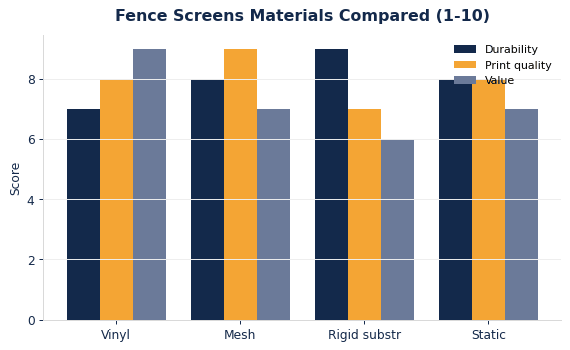
Nearly every custom fence screen on the market today is either knitted HDPE (high-density polyethylene) mesh or a woven vinyl-coated polyester. The two look similar rolled up, but they behave differently once they’re stretched across 50 feet of chain link or wood rail. Knitted HDPE uses a criss-cross Raschel knit that lets air bleed through the fabric, which is why it’s the more common choice for exposed yards and anywhere wind is a factor. Woven vinyl mesh has a tighter, more uniform weave and a heavier hand-feel, and it’s typically chosen when the buyer wants maximum opacity and doesn’t mind the extra load a solid-feeling panel puts on fence posts.
Weight is quoted in ounces per square yard, and it climbs with privacy density. A 70% blockage knitted panel typically runs around 8.25 oz, while a 95% solid knitted panel runs closer to 9.5 oz, according to custom tarp fabricator Lookout Mountain Tarp. Heavier isn’t automatically better — a heavier, denser panel on a fence line that catches wind is the fastest way to bend line posts or tear grommets out at the corners.
Knitted vs. woven: which to pick
If your fence sits along an open lot, a corner exposed to prevailing wind, or anywhere gusts regularly top 20-30 mph, knitted HDPE mesh in the 70-85% range is the safer call — the open knit sheds wind instead of catching it. Woven vinyl mesh at 90%+ makes more sense for sheltered yards, courtyards, or short runs where blocking sightlines matters more than airflow.
How much custom fence screens cost
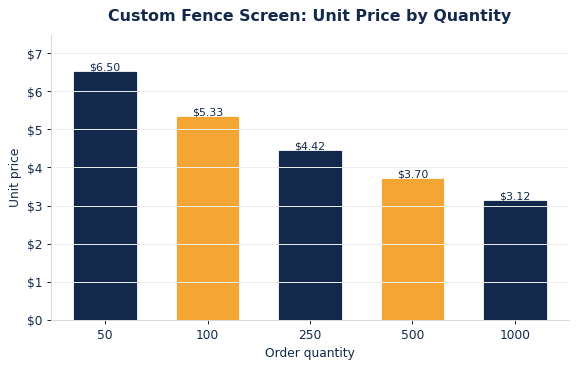
Pricing scales with length, not just square footage, because setup and finishing (hemming, grommeting, reinforced corners) get spread across more material on longer runs. The chart below uses actual listed prices for 6 ft tall custom-cut fence screens sold through Home Depot’s ColourTree line, which publishes per-size pricing rather than requiring a quote request.
Choosing a privacy percentage
Privacy percentage — sometimes listed as shade factor or blockage rate — tells you roughly how much airflow the panel also stops, since the two move together. An 85% privacy screen blocks close to 85% of the wind hitting it, not just 85% of the view. That trade-off is the main decision buyers get wrong: they order the highest blockage number without checking what it does to wind load on the fence itself.
The table below breaks out the three common density bands and where each one actually fits, based on wind-load and airflow guidance from fence screen suppliers.
| Mesh Density | Approx. Wind Transmission | Best Use |
|---|---|---|
| 70-80% privacy | 20-30% of airflow passes through | Open lots, coastal sites, fence lines that catch prevailing wind |
| 85-90% privacy | 10-15% of airflow passes through | Standard backyard privacy — the workhorse range for most homes |
| 95%+ / solid | Under 5% of airflow passes through | Sheltered, low-wind runs where maximum visual blocking matters most |
Sizing, grommets, and installation
Order custom fence screens to the actual fence dimensions, not the nominal fence height. A “6 ft” fence often measures 70-71 inches from grade to top rail once you account for the gap at the bottom, so a true 6 ft (72 in) panel usually leaves a small ground clearance gap on purpose — useful for mowing and drainage, and worth confirming with the seller rather than assuming full coverage.
Reinforced grommets are the standard fastening point, typically spaced every 12 inches along the vertical edges with an extra grommet at each corner for load distribution. Panels are usually attached with UV-stable zip ties or cable ties threaded through the grommets and around the fence framework every 12-24 inches. Skipping grommets in favor of gluing or stapling a panel directly to wood fencing voids most warranties and tends to fail within a season, since the fabric has nothing to flex against in wind.
Double-check hem construction before you buy: a folded, sewn hem around all four edges resists tearing at the grommet points far longer than a raw-cut edge with grommets punched straight through the material.
Ordering, lead times, and minimums
Unlike printed event fencing, which some suppliers sell only in bulk (one vendor requires a 150 ft minimum order for printed event barrier fencing), cut-to-size custom fence screens are generally sold as single panels with no minimum order — you can buy exactly one panel sized to one fence section. Custom printing adds a design and proofing step, but plain custom-cut privacy screens in stock colors don’t require it.
Turnaround varies by how much customization you’re asking for. Suppliers commonly quote 2-4 weeks for fully custom production runs, while others promise 5-7 business days once you sign off on a digital proof. If you only need a stock color cut to a custom length with no printing, some retailers process and ship the next business day. When a deadline matters — an HOA compliance date, an event, a move-in — ask the seller directly which of those three timelines applies to your order, since the terms “custom” and “made to order” get used loosely across the industry.
Frequently asked questions
What size custom fence screen do I need?
Measure the actual fence height at the post, not the nominal size — a “6 ft” fence often measures a few inches short once you account for the ground gap. Measure the full run length in one continuous stretch where possible, since a single custom panel installs faster and has fewer seams than piecing together several stock rolls.
What privacy percentage should I choose for a windy yard?
Stay in the 70-85% range on exposed fence lines. Wind transmission tracks closely with privacy percentage, so a 95% panel on a windy corner puts significantly more load on your posts than an 85% panel, even though the visual difference between the two is small at normal viewing distance.
How long do custom fence screens last outdoors?
Knitted HDPE mesh with UV stabilizers commonly carries a 3-year warranty from manufacturers, with real-world lifespan often longer in mild climates and shorter in high-UV, high-wind regions. Reinforced hems and properly spaced grommets are the biggest factors in whether a panel fails early from tearing versus simply fading over time.
Can I install a custom fence screen myself?
Yes — grommeted panels are designed for DIY installation with UV-stable zip ties or cable ties, no special tools required. Budget roughly 12-24 inches between ties along the frame and don’t skip the corner grommets, since those carry the most load in wind.
Do custom fence screens require a minimum order?
Cut-to-size privacy panels typically don’t — most suppliers sell a single custom panel sized to one fence section. Minimum order quantities show up more often on printed event fencing or bulk commercial jobs, not standard residential privacy screens.
The bottom line
The panels that hold up longest aren’t necessarily the priciest ones — they’re the ones matched to the site. Pick a privacy percentage that fits your actual wind exposure, confirm the hem and grommet spacing before you buy, and measure the real fence dimensions rather than the nominal size. Do that and a set of custom fence screens sized to your exact fence line will outlast a cheaper stock roll cut down at home, at a comparable per-foot cost once you’re ordering more than a few feet of material.