Great fence screen artwork is simple, high-contrast and built to be read from a distance: a vector logo, a short message, bold colors and nothing important near the hems or grommets. Custom Fence Screens turns your files into a free mockup within 24 hours, so you can check scale, color and panel layout before anything prints.
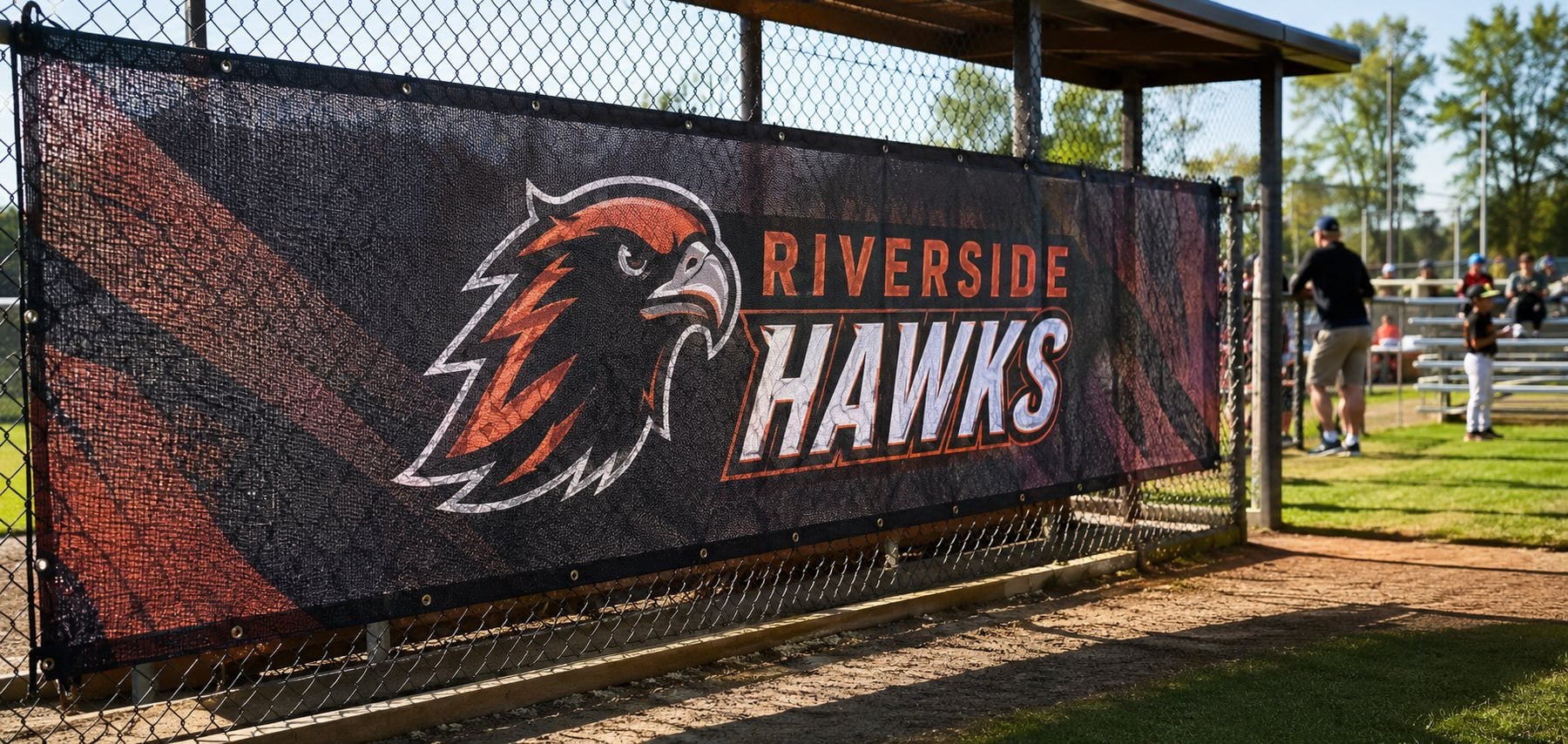
- Vector logos (AI, EPS, SVG or vector PDF) print sharpest at fence-screen scale
- Keep text and logos clear of hems, grommets and zip-tie points
- Free mockup within 24 hours, unlimited free revisions
- Minimum order 12 screens; standard turnaround about 2 weeks
- Pay nothing until you approve the design
What makes fence screen artwork different from other printed graphics?
Fence screen artwork is viewed from far away, at an angle and often through moving traffic, so the design rules are closer to a billboard than a brochure. A logo that looks crisp on a business card can turn into a smudge when it is stretched across a long run of chain-link and seen from across a parking lot or from the top row of the bleachers.
Three things change when your design moves onto fence screens:
- Viewing distance. People read the screen from the sidewalk, the street, the dugout or the stands, not from arm’s length. Fine detail disappears first.
- Material. Printed mesh lets air and light pass through, which softens thin lines and pale colors. Solid vinyl and solid privacy mesh hold detail differently from open mesh.
- Hardware. Every screen has hems and grommets along the edges, and installers add zip ties or bungees at those points. Anything printed in that zone can be partly hidden.
Designing for those conditions from the start saves revision rounds and gives you a screen that actually does its job, whether that job is sponsor visibility, construction branding or a clean HOA perimeter.
Which logo file formats work best for custom fence screens?
Vector files work best for custom fence screens because they scale to any size without losing sharpness. If your logo exists as an AI, EPS, SVG or a PDF exported from a design program with the vector data intact, send that version. Vector artwork keeps edges clean even when a mark is enlarged to span a full panel.
Raster files such as JPG and PNG can still work, but only when they are large and high resolution. A small logo pulled from a website or an email signature usually looks soft or blocky once it is blown up to fence-screen scale. If a raster file is all you have, send the largest original you can find and let the art team review it in the mockup.
| File type | How it prints on fence screens | Best use |
|---|---|---|
| AI / EPS / SVG | Sharp at any size, easy color matching | Logos, wordmarks, sponsor marks |
| Vector PDF | Sharp if exported with vectors intact | Finished layouts from a designer |
| Large PNG / JPG / TIFF | Acceptable when the original is large | Photos and full-bleed backgrounds |
| Web logo or screenshot | Usually soft or pixelated when enlarged | Reference only; ask for a rebuild |
Outline your fonts or include the font files so the lettering prints exactly as you designed it.
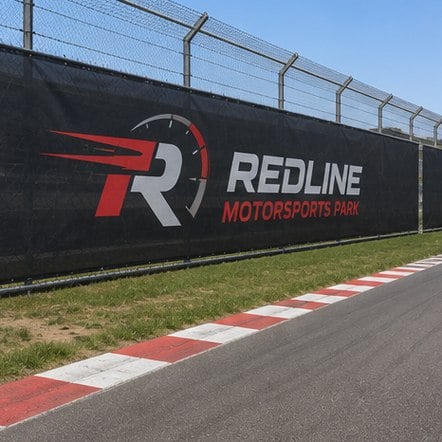
How big should the logo and text be on a fence screen?
The logo and text on a fence screen should be as large as the layout allows, because distance shrinks everything. A useful rule of thumb is to decide where the closest and farthest viewers will stand, then design for the farthest one. A ballfield outfield wall is read from home plate and the stands; a construction windscreen is read from passing cars; a pool or tennis enclosure is read from inside the court and from the walkway.
Practical ways to keep a fence screen readable:
- Limit each panel to one main message: a logo, a team name or a short line such as a phone number or website.
- Use bold, simple typefaces. Thin scripts and light weights break up on mesh.
- Leave generous empty space around the logo so the eye finds it instantly.
- Repeat the logo along a long fence run instead of placing one tiny version in the middle.
The mockup from Custom Fence Screens shows your artwork at true proportion on the panel, which is the easiest way to judge scale. If the logo looks small on the mockup, it will look smaller on the fence.
Where are the safe zones on a fence screen with hems and grommets?
The safe zone on a fence screen is the inner area away from the hemmed edges and grommet line. Hems are folded and stitched, grommets punch through the material, and installers wrap zip ties or bungees around the fence at each grommet. Any text or logo that sits in that border can be folded, punctured or covered.
Keep these elements well inside the edges:
- All lettering, including small lines such as websites and phone numbers
- The main logo and any sponsor marks
- QR codes, which must be fully visible and flat to scan
Background colors and patterns, on the other hand, should run all the way to the edge so the finished screen looks complete. Think of the design in two layers: a background that fills the whole panel and a content layer that stays comfortably inside the hems. The art team flags anything that sits too close to the edge when they build your mockup, so you can adjust before approving.
What about wind slits?
Wind slits or half-moon cuts reduce wind load on solid screens, but they also cut through artwork. Placing text between slit rows, rather than across them, keeps words intact.
Which colors stay readable on printed mesh and vinyl fence screens?
High-contrast color pairs stay most readable on fence screens: dark text on a light background, or white and bright colors on a dark background. Because printed mesh is open, some of the fence and the scene behind it shows through, which lowers contrast. Pale grays, pastel yellows and light-on-light combinations tend to wash out first.
Color choices that work well outdoors:
- Black, navy or deep green backgrounds with white or bright logo colors
- White backgrounds with dark, saturated lettering
- A single accent color for the key word or call to action
If your brand guide includes specific color values, include them with your files so the print can be matched as closely as the material allows. Solid privacy mesh and heavy-duty PVC vinyl show colors more densely than open mesh, so a design that leans on subtle color shifts is a better fit for those materials. The solid privacy mesh screen and PVC vinyl fence banner pages explain how each material handles full-color graphics.
How do you design artwork that continues across several fence screen panels?
Artwork that spans several fence screen panels needs a planned layout so each seam lands in a sensible place. Long fence lines are usually covered by multiple screens hung side by side, and a single image or slogan stretched across them will be split at every seam. Planning the breaks keeps faces, letters and logos from being cut in half.
- Measure the full run and note posts, gates and corners where the fence changes direction.
- Decide on a pattern: one repeating design on every panel, alternating designs, or a continuous mural.
- Put seams in empty space such as background color, never through a word or the center of a logo.
- Number the panels in the layout so the installer hangs them in the right order.
Repeating designs are the simplest and most forgiving, because any panel can go anywhere. Continuous murals are striking for stadium wraps and long construction perimeters but need careful placement. Custom Fence Screens can mix designs within one order, so a sponsor wall can carry a different logo on each panel while sharing one background.
What artwork mistakes cause the most revisions on fence screen orders?
The most common fence screen artwork mistakes are too much text, low-resolution logos and important content placed at the edges. Each one is easy to fix before printing and frustrating to discover after the screens are zip-tied to the fence.
- Packing in copy. Lists of services, long slogans and full addresses are unreadable from a distance. Choose one message per panel.
- Using a web logo. Small images from a website enlarge poorly. Ask your designer or printer for the original vector file.
- Ignoring hems and grommets. Text near the border gets folded or covered by ties.
- Low contrast. Light colors on light backgrounds fade into the scene behind open mesh.
- Fine detail. Thin outlines, small icons and gradients with subtle steps soften on mesh.
- Forgetting the back side. Most screens are printed on one face, so plan which side faces the audience before ordering.
Catching these issues is exactly what the mockup stage is for. Review it at full screen size, imagine standing where your audience stands, and ask for changes until it reads clearly.
How does the mockup and proof approval process work at Custom Fence Screens?
Custom Fence Screens sends a free digital mockup within 24 hours of receiving your artwork and request, and you pay nothing until you approve the design. The mockup shows your logo, text and colors laid out on the screen so you can check scale, safe zones and panel order before production starts.
- Send your logo files, fence measurements and where the screens will hang through the custom quote form.
- Review the mockup and request any changes. Revisions are unlimited and free.
- Approve the final proof once the layout, spelling and colors are right.
- Production and delivery follow, with a standard turnaround of about 2 weeks and faster options available with express shipping.
The minimum order is 12 screens, and one order can include a mix of designs for different sections of fence. The how it works page walks through the full ordering process, and the full-color printed mesh banner page shows the most popular style for detailed logo artwork.
Frequently asked questions
Can a fence screen print a photo instead of a logo?
A fence screen can print a full-color photo, but the image needs to be a large, high-resolution original rather than a web download. Photos work best as backgrounds or as one bold focal image, with any text placed on a clean area of contrast. Custom Fence Screens reviews photo quality in the free mockup and flags images likely to look soft once enlarged.
Should fence screen text be printed in all capital letters?
Fence screen text reads well in either bold capitals or bold mixed case, as long as the typeface is heavy and simple. All capitals suit short words such as a team name or a single call to action. Longer lines, like a website or a slogan, are often easier to read in mixed case because word shapes help people recognize them quickly from a distance.
Will a QR code scan from a printed fence screen?
A QR code on a fence screen can scan when it is printed large, in dark ink on a light background, and kept flat inside the safe zone away from grommets. Open mesh can interfere with scanning, so solid privacy mesh or vinyl is a better choice for codes. Placing the code where people walk close by, rather than across a field, also helps.
Do sponsor logos on a fence screen all need the same file format?
Sponsor logos on a fence screen do not need matching formats, but each one should be the best original the sponsor can supply, ideally vector. Collecting files early avoids delays, because sponsors often send small web images first. Custom Fence Screens can place several sponsor marks across one order and show each panel in the mockup so every sponsor can approve their placement.
How much text is too much for a fence screen panel?
A fence screen panel usually carries too much text once it holds more than a logo plus one short line. Viewers glance at fence graphics while walking or driving, so lists of services, addresses and long taglines get skipped. Choose the single message you want remembered, such as a name, website or phone number, and repeat it across panels rather than crowding one.
Can fence screen artwork wrap around a corner or a gate?
Fence screen artwork should break at corners and gates rather than wrap around them, because each screen hangs flat on one section of fence. Plan separate panels for each straight run and keep seams in background areas. Gates usually get their own screen so they can open freely. The mockup from Custom Fence Screens can show each section separately so placement is clear.
Should a fence screen design look the same from both sides of the fence?
Fence screen designs are normally printed on one face, so the audience side should be decided before ordering. The reverse shows a lighter, mirrored image on open mesh and plain material on solid screens. If both sides matter, such as a fence between a field and a parking lot, ask about options during the quote so the layout and material can be planned together.
What background color hides dirt best on a fence screen?
Darker fence screen backgrounds such as black, navy, charcoal or deep green tend to hide dust, splashback and construction grime better than white. They also make white and bright logos stand out from a distance. White backgrounds look crisp but show dirt sooner on job sites and sports fields. Choose the background with the setting in mind, then match logo colors for contrast.
Can a fence screen design include a team roster or list of names?
A fence screen can include a roster or list of names, such as seniors, champions or donors, as long as the names are large enough to read from where people stand. Long lists work better split across several panels with a shared header. Custom Fence Screens can vary panel content within one order, so each screen can carry a different group of names.
Who checks the spelling on custom fence screen artwork before printing?
Spelling on custom fence screen artwork is confirmed by you at the proof stage, with the art team flagging anything that looks off. Read every word on the mockup, including websites, phone numbers and sponsor names, and have a second person check it too. Nothing goes to print until you approve, and revisions are free, so correcting a typo costs only a quick reply.
Can I send a hand sketch for my fence screen design?
A hand sketch is a helpful starting point for a fence screen design when it comes with your logo files and notes on colors and wording. The sketch shows the layout you have in mind, and the art team rebuilds it as clean print-ready artwork. Custom Fence Screens returns that layout as a free mockup within 24 hours for you to review and refine.
Get a free mockup for your fence screens
Send your logo or idea and the quantity you have in mind. Custom Fence Screens returns a free mockup within 24 hours, you approve the design before anything is produced, and standard turnaround is about two weeks with faster options available. Get a custom quote.