Category: Uncategorized

  • How Long Do Custom Fence Screens Last? UV, Wind, and Getting More Seasons Out of Them

    How Long Do Custom Fence Screens Last? UV, Wind, and Getting More Seasons Out of Them

    A custom fence screen is an outdoor textile that fights sun, wind, and grit every single day it hangs. That is why the honest answer to “how long will it last” is a wide one: depending on the material and how it is hung and maintained, a fence screen lasts roughly 1 to 10 years. The spread is not random. It comes down to the polymer you start with, the opacity you choose, and how well the screen and the fence share the wind between them.

    What actually wears a fence screen out

    Sunlight is the main clock. Ultraviolet light slowly breaks down the plastic in the fabric, first fading the color and then making the fibers brittle until they split at the points that carry the most stress. Wind is the second force: constant flexing fatigues the material and tugs at the grommets and hems that hold it to the fence. Add abrasion where the screen rubs against chain-link, plus trapped dirt and mildew that hold moisture against the fibers, and you have the full picture of what ages a screen. Because UV and wind do most of the damage, the two things worth paying for are a fabric that resists sunlight and a hanging method that keeps wind load under control. Climate tips the scale as well: intense year-round sun in the South and Southwest ages a screen faster than the same fabric in a cloudier, milder region, so a lifespan that reads as generous in one market can run short in another.

    Material sets the baseline

    The cheapest screens use lightweight polyethylene and last about 1 to 3 years outdoors before they fade and go brittle. High-density polyethylene, or HDPE, knitted mesh is the standard for durability, and entry-level HDPE often carries a 2 to 3 year warranty even though real service life with reasonable care usually runs longer. Heavy-duty HDPE, made with thicker yarns, a denser knit, and ultraviolet inhibitors built into the resin, is what reaches the top of that 1 to 10 year band. Printed screens add one more variable, because the lifespan depends on the ultraviolet package in the ink and coating as much as on the base fabric.
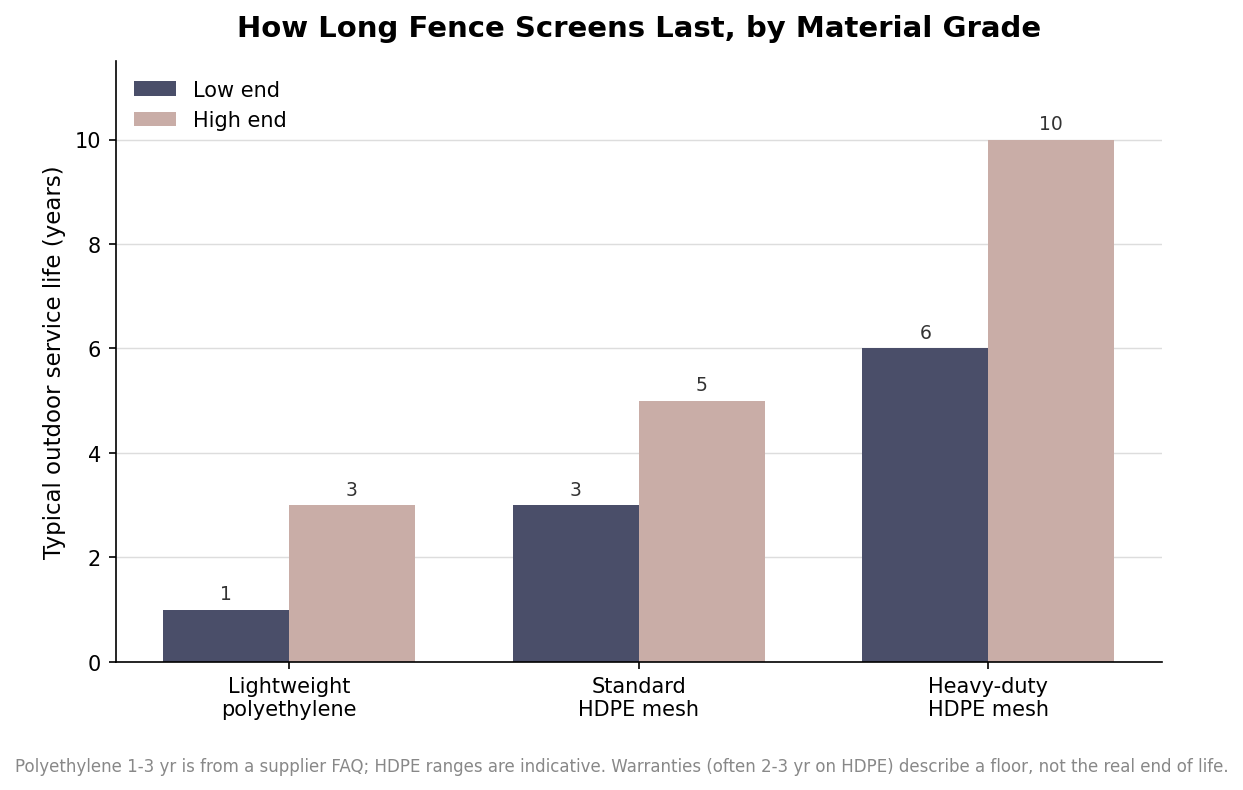
    Grouped bar chart of low and high outdoor service life in years for lightweight polyethylene, standard HDPE, and heavy-duty HDPE fence screens
    Heavier, UV-stabilized HDPE reaches the top of the 1-to-10-year range; lightweight polyethylene sits at the bottom.

    Within HDPE, three specifications separate a two-season screen from a ten-season one. Fabric weight matters because a heavier knit puts more polymer between the sun and the yarn cores. Denier, the thickness of the individual yarns, decides how much abrasion and flexing the fabric shrugs off. And whether ultraviolet inhibitors are compounded into the resin, rather than sprayed on, determines how fast the sun does its work. Treat the warranty as a useful proxy for a manufacturer’s confidence, not as the moment the screen dies. As a rough rule, each step up in weight and denier buys both a few more seasons of life and a screen that holds its printed color longer before it chalks and fades.

    Opacity is a durability decision, not just a privacy one

    The block percentage you choose is also a wind decision. A screen rated at 85 percent stops roughly 85 percent of the wind and lets the remaining 15 percent bleed through. Higher opacity blocks more wind, but it also transfers more load to your fence, because a near-solid 95 to 98 percent screen behaves like a sail. Lower-opacity mesh in the 70 to 85 percent range actually survives storms better, since the air passing through fills the low-pressure pocket behind the screen and relieves the stress that would otherwise tear it or flatten the fence. The denser the screen, the more force both it and your posts have to survive.
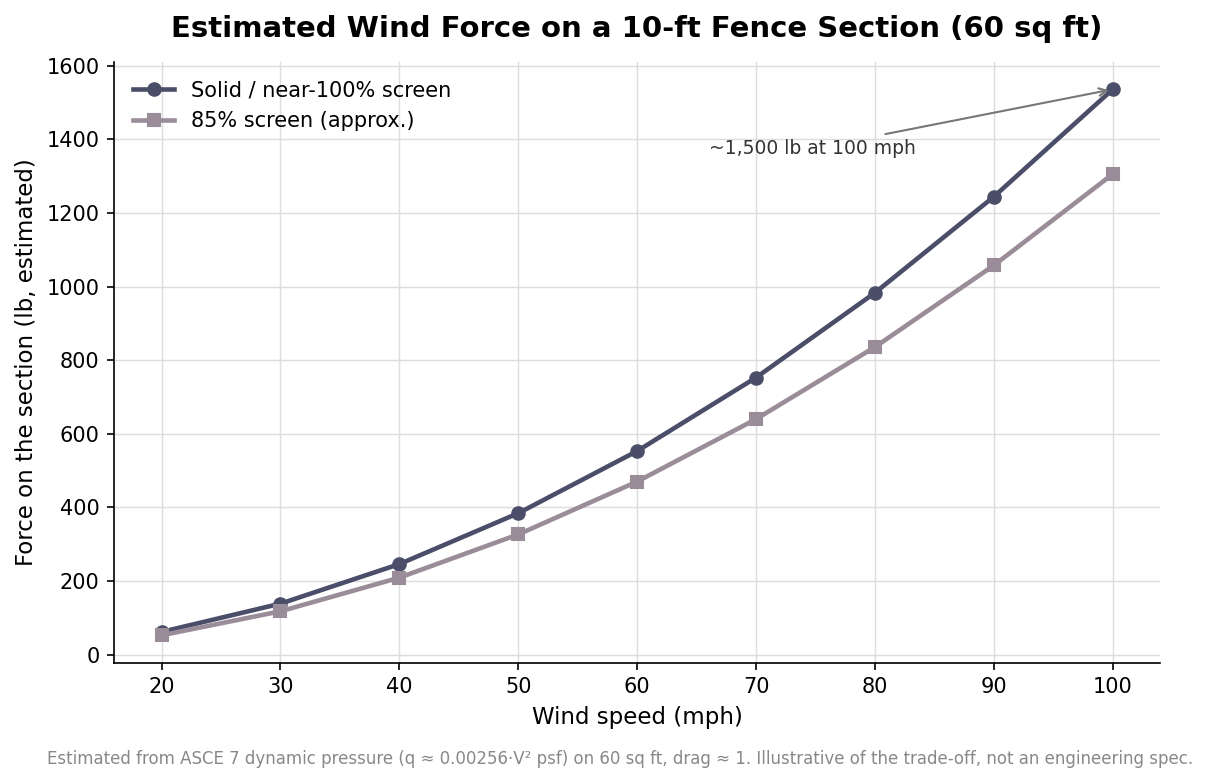
    Line chart estimating wind force in pounds on a 60 square foot fence section as wind speed rises, for a solid screen versus an 85 percent screen
    Wind force climbs with the square of speed, and a denser screen carries more of it to the fence.

    The reason this matters so much is that wind force grows with the square of wind speed: doubling from 30 to 60 miles per hour roughly quadruples the load. Under standard ASCE 7 assumptions at 100 miles per hour, a single 10-foot section presenting about 60 square feet of solid surface can see on the order of 1,500 pounds of force. That is why high-opacity screens on exposed sites need stronger posts, tighter post spacing, and often wind vents. Vents help relieve gusts, but they are a partial measure rather than a replacement for proper structure.

    Getting more seasons out of a screen

    Installation and care decide where in the range you land. Hang the screen taut but not drum-tight, and fasten it often enough, commonly every 6 to 12 inches, that no section is left to flap in the wind, since flapping is what fatigues fabric and rips out grommets. On exposed runs, leave wind gaps or choose vented panels rather than fighting the load with fabric alone. Keep the screen clean by rinsing off dirt and treating mildew, because grime and abrasion speed up ultraviolet wear. Where it is practical, take screens down ahead of extreme storms or over an off-season. And buy for the actual environment: a full-sun, high-wind, or coastal site justifies heavy-duty UV-stabilized HDPE, because replacing a cheap screen every other year quietly costs more than installing one good one.

    Match the material to the exposure

    A shaded, low-wind residential run can get away with lighter mesh and still look good for years. An exposed commercial yard, a sports field, or a coastal property should start from heavy-duty, UV-stabilized HDPE and then size the structure for the opacity chosen, not the other way around. The screen and the fence age together as a system, and the fabric you pick along with the way you hang it is what decides whether that system gives you three seasons or ten.
  • Fire-Rated Fence Screens and NFPA 701: What Inspectors Actually Require

    Fire-Rated Fence Screens and NFPA 701: What Inspectors Actually Require

    A printed fence screen can be perfect on paper and still get pulled off the fence by an inspector on day one. The reason is almost always the same: the material has no flame-resistance certificate, or the certificate does not match what the fire code on that project actually requires. On construction sites, event perimeters, and many public venues, flame resistance is not an upgrade you choose for peace of mind. It is a line item the authority having jurisdiction can enforce, and understanding the standard behind it keeps a job from stalling at inspection.

    What NFPA 701 actually tests

    The standard most codes point to for temporary fabrics and films is NFPA 701, a test method that has been around since 1938 and is revised on a regular cycle. It does not certify that a material is fireproof. It measures flame propagation, meaning how readily a flame spreads across the fabric once an ignition source is removed. A screen that passes will self-extinguish rather than carry fire along a fence line, which is exactly the behavior a fire marshal cares about when a windscreen wraps hundreds of linear feet of perimeter.

    Because editions are year-stamped, the specific version matters. A material that passed an older edition is not automatically compliant with a newer one, so the certificate you keep on file should name both the standard and its edition, and it should describe the exact material that is hanging on your fence.

    Method 1 versus Method 2, and why screens use Method 2

    NFPA 701 contains two test methods that are not interchangeable. Test Method 1 is built for lightweight, single-layer textiles such as drapery and curtain fabrics. Test Method 2 uses a larger specimen and different apparatus and is the one written for heavier materials: vinyl-coated fabrics, plastic films, banners, awnings, and membrane or temporary enclosures. A printed vinyl mesh fence screen or a coated windscreen falls squarely in Method 2 territory, so a certificate that only references Method 1 is testing the wrong class of material for this application. This is one of the most common reasons a screen fails a paperwork check even when the fabric itself would have passed: the test was run, but on the wrong method for the product. When you request certification, name the material type as well as the standard, so the laboratory result describes the coated mesh you are actually installing rather than a lighter fabric that happens to share a product line.

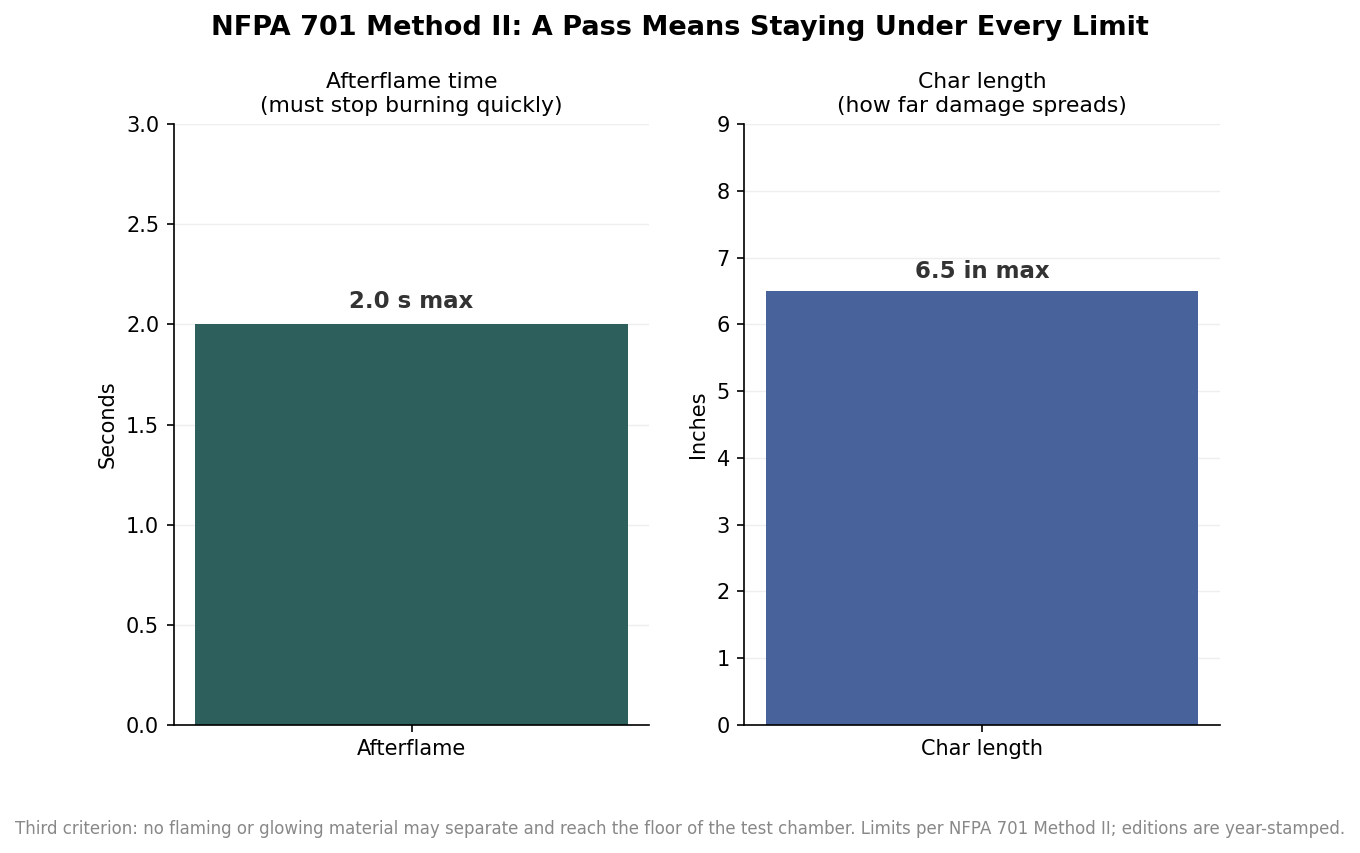
    Two bar charts showing NFPA 701 Method II pass limits: afterflame under 2 seconds and char length under 6.5 inches
    A screen passes NFPA 701 Method II only by staying under every limit at once.

    Reading a pass: the three limits

    Under Method 2, a specimen passes only if it stays inside three boundaries at once. The afterflame time, the interval the material keeps burning after the flame is withdrawn, must stay under two seconds. The char length, how far the damage travels along the specimen, must stay under 6.5 inches. And no flaming or glowing piece may break away and reach the floor of the test chamber, because burning debris is its own ignition hazard. Missing any one of the three is a failure, which is why “it looked like it self-extinguished” is not the same as a documented pass. The value of the certificate is that a laboratory measured all three, on a real specimen, under a controlled ignition, and recorded numbers rather than an impression. That paper trail is what an inspector can accept without having to trust a visual judgment made in the field, and it is why keeping the certificate physically on site, rather than in an email thread, saves time when someone official asks to see it.

    Treated versus inherently flame resistant

    Two screens can both carry a passing result and still age very differently. A topically treated material gets its flame resistance from a chemistry applied to the surface, and outdoor exposure, rain, and cleaning can gradually diminish it. An inherently flame-resistant material builds the property into the fiber or film, so it holds up better over a long deployment. This distinction is why some jurisdictions ask for more than a one-time test result; a fire marshal may want evidence that the flame resistance will survive the planned service life of the installation, not just the day it was manufactured. When a screen will hang through a multi-year build, ask which type you are buying and what the manufacturer says about weathering, and confirm that outdoor UV inhibitors are part of the same specification so the graphic and the protection last together.

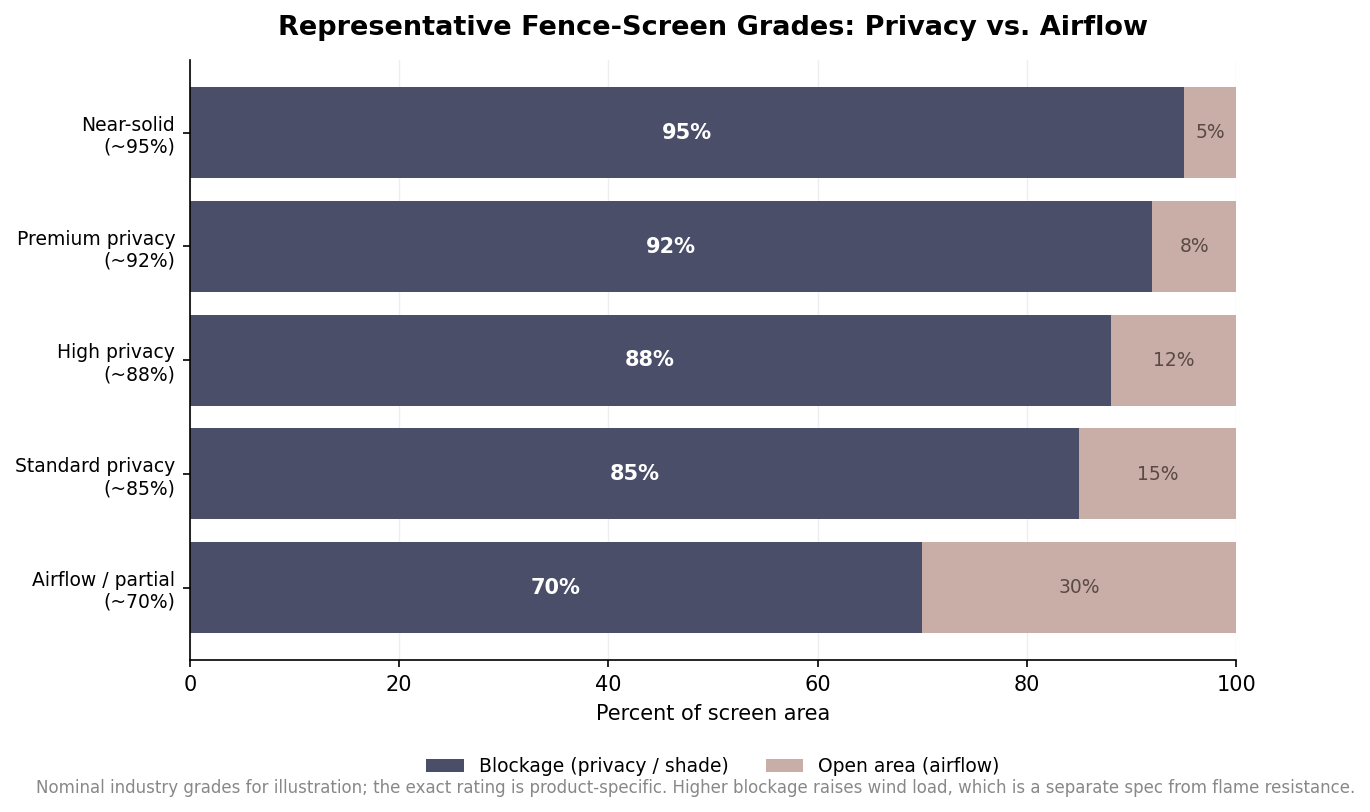
    Stacked horizontal bar chart of representative fence-screen grades showing blockage percentage versus open area for airflow
    Privacy and airflow are set by the blockage grade; flame resistance is a separate certification on top.

    Where the requirement comes from, and how to specify around it

    Flame resistance rarely arrives as a standalone rule. On a job site it usually sits under a broader framework such as NFPA 241, the standard for safeguarding construction, alteration, and demolition operations, which pushes a fire-prevention program onto temporary sites, with the local fire code and inspector filling in the specifics. Practically, that means the two decisions you make for privacy and wind are separate from the one you make for fire. First choose a blockage grade for the sightline and airflow the site needs, remembering that a higher blockage percentage also raises the wind load the fence has to carry. Then require, in writing, an NFPA 701 Method 2 certificate for the exact material and edition, keep a copy on site, and confirm the flame resistance is durable enough for how long the screen will hang. Handle those as distinct line items on the order and the screen clears inspection instead of coming down.

  • How to Install a Fence Screen on Chain-Link: Fasteners, Spacing, and Wind Gaps

    How to Install a Fence Screen on Chain-Link: Fasteners, Spacing, and Wind Gaps

    A printed fence screen only looks as good as its installation. Get the fasteners and spacing right and the panel sits flat, reads cleanly from across a field, and survives a storm. Get them wrong and you end up with a sagging, flapping banner that frays at the grommets within a season. This walkthrough covers how to hang a screen on standard chain-link the way commercial installers do it, with the spacing and tensioning details that most first-time buyers miss.

    Start with the fence, not the screen

    Before anything gets unrolled, confirm the fence can carry the load. A fence screen turns an open chain-link fence into a solid sail, and the wind force involved is larger than people expect. Using ASCE 7 wind-load assumptions, a single 10-foot section that is 6 feet tall presents roughly 60 square feet of surface, and at a 100 mph design wind that section can see on the order of 1,500 pounds of force before you even account for gusts. That is why screening is best suited to fences with concrete-set line posts, a top rail, and, ideally, a bottom tension wire. If your posts are loose in the ground or the mesh is already leaning, screening will accelerate the failure rather than hide it. Walk the line first and reset any post that moves when you push on it.

    Measure the run and the height while you are there. Order the screen to the fabric height of the fence, and plan to overlap adjoining panels by a few inches at the seams so there is no gap where two rolls meet. If the fence has gates, treat each gate as its own panel so the screen can swing with it.

    Attach to the mesh side, and hang from the top first

    Screens go on the chain-link side of the fence, not the post side. Mounted against the posts, the fabric rubs the rail and framework every time the wind moves it and wears through at the contact points within a season or two. On the mesh side it lies against a flat, continuous surface and moves as one piece.

    Hang the top edge first. Secure it lightly to the top rail along the whole panel before you tighten anything, stepping back to check that the print is level and the top hem is riding straight. Only once the top is aligned do you work the sides from top to bottom, pulling small wrinkles out as you go, and finish with the bottom edge last. Tension is applied in that order for a reason: if you lock the bottom corners down before the top is square, every wrinkle above them gets trapped and there is no way to work it out without cutting ties.

    Fastener spacing is the detail that decides longevity

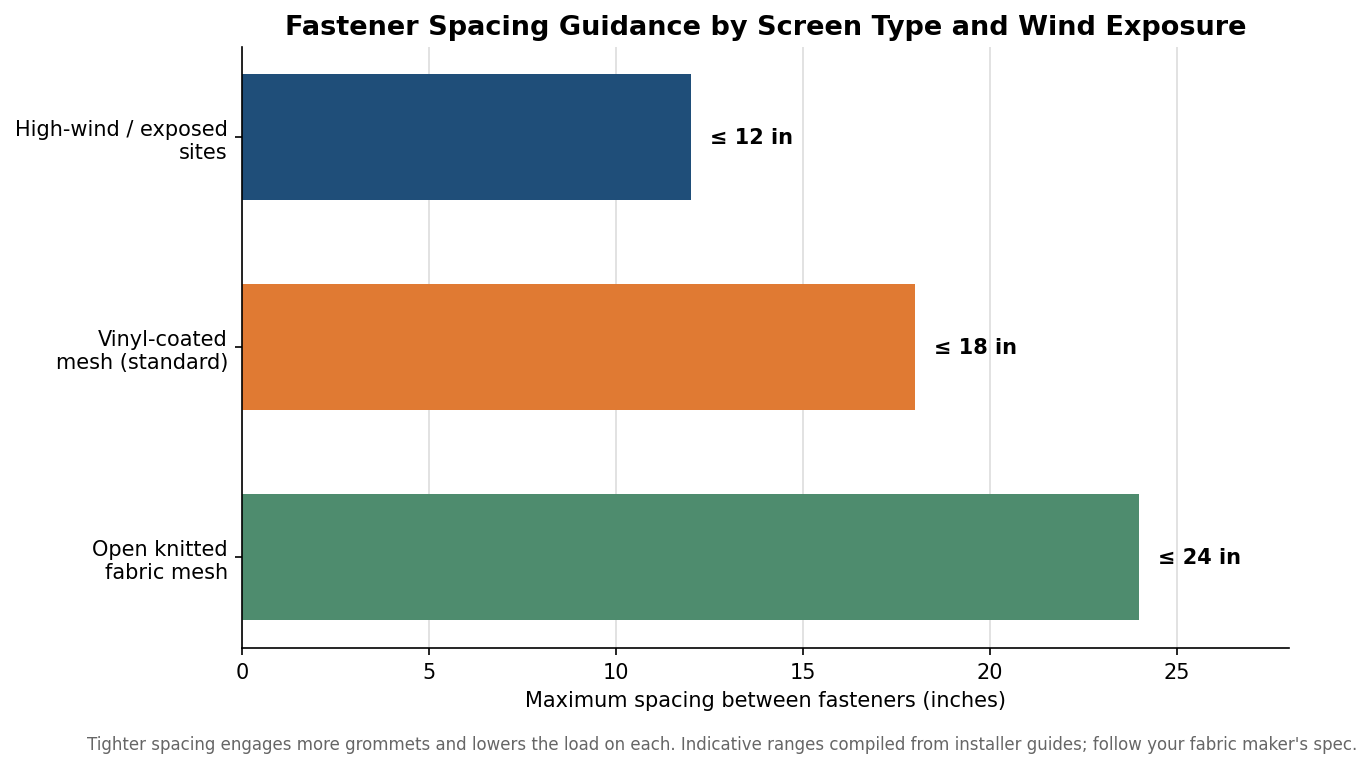
    Reinforced screens are built with grommets on roughly 12-inch centers around the hem, and the general rule is to engage every grommet you can rather than skipping down the line. How tightly you space the ties themselves depends on the fabric and the exposure. For heavier vinyl-coated mesh in ordinary conditions, a fastener every 12 to 18 inches is typical; lighter open-knit fabric mesh can often go 18 to 24 inches; and on exposed, high-wind sites you tighten everything to 12 inches or less. Closer spacing is not busywork. Each additional tie shares the wind load, so halving the spacing roughly halves the force each grommet has to hold, which is exactly what keeps grommets from tearing out along the top edge where the load concentrates.

    Horizontal bar chart of maximum fastener spacing by screen type: high-wind sites 12 inches, vinyl-coated mesh 18 inches, open knitted fabric mesh 24 inches
    Recommended maximum spacing between fasteners, tighter on exposed sites and heavier mesh.

    Use UV-rated fasteners, and match strength to position. A common commercial pattern is lighter 50-pound-test ties along the top and upper sides and heavier 120-pound-test ties along the bottom and lower sides, where the fabric wants to lift and billow. UV-treated zip ties are the default; stainless hog rings suit high-traffic facilities, and bungee ball ties are used on the most wind-exposed runs because they give a little in a gust instead of snapping. Whatever you use, buy UV-rated. Standard nylon ties from a hardware bin go brittle in sunlight and start shedding within a year, and many fabric warranties are voided by non-approved fasteners, so it is worth checking the spec before you buy a bag of the wrong thing.

    Leave the screen room to breathe

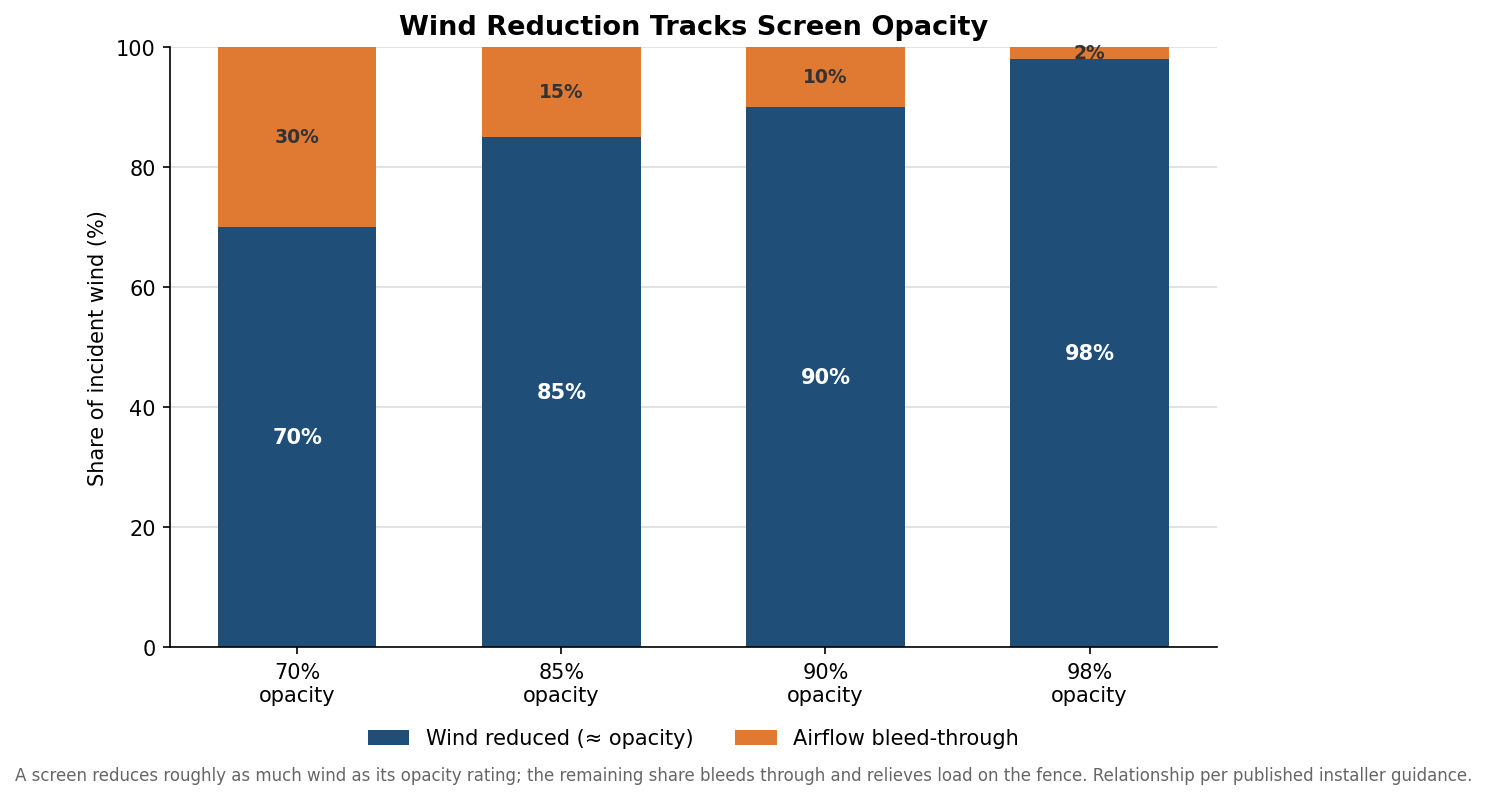
    The instinct to seal a screen tight to the ground is the single most common installation mistake, and it is the one most likely to bend a fence line in a storm. A screen blocks wind in near-direct proportion to its opacity: a panel rated at 85% blockage stops roughly 85% of the wind that hits it and lets the remaining 15% bleed through. That bleed-through is not a defect, it is the pressure-relief valve that keeps the whole assembly standing.

    Stacked bar chart showing wind reduction versus airflow bleed-through for 70, 85, 90 and 98 percent opacity screens
    Wind reduction tracks opacity; the airflow that bleeds through is what relieves load on the fence.

    Two habits follow from that. First, leave a few inches of gap at the bottom of the panel so air has somewhere to go rather than loading the entire surface. Second, match opacity to exposure rather than defaulting to the most private option. On a sheltered courtyard a 90% or 98% screen is fine and gives near-total privacy. On an exposed ballfield or a rooftop, a 70% to 85% screen that breathes will outlast a near-solid one that turns the fence into a sail. If your priority is ball visibility on an athletic field, a 70% screen deliberately trades some privacy for that airflow. The right number is a wind-versus-privacy decision, not simply the highest blockage available.

    Final pass and upkeep

    Once the panel is up, walk the full length and do a final tightening, squaring the fabric against a tension bar or the fence framework as your straightedge. Angle the bottom ties slightly toward the taut corner to pull residual wrinkles flat, but stop short of stretching the fabric drum-tight; over-tensioning puckers the print and stresses the grommets just as badly as leaving it slack. Twice a year, walk the line again and replace any tie that has cracked or worked loose, especially along the top edge. A screen that is checked and re-tied on that cadence will typically hold its shape and color for years; one that is hung tight, sealed to the ground, and never touched again is the one that fails early. The install is not hard, but the details, correct side, top-down tensioning, tight enough spacing, and a deliberate wind gap, are what separate a screen that reads like signage from one that reads like a tarp.

  • How to Specify a Custom Fence Screen: Shade Percentage, Fabric Weight, and Hardware

    How to Specify a Custom Fence Screen: Shade Percentage, Fabric Weight, and Hardware

    Specifying a custom fence screen comes down to a handful of numbers, and getting them right matters more than the artwork printed on top. A screen that is too dense for an exposed site can drag down a fence in a storm; one that is too light gives away the privacy you were paying for; and hardware chosen without thought is where most field failures start. If you can answer four questions with actual figures, you can order a screen that does its job for years instead of one you are re-tensioning every season.

    Those four questions are how much you need to block, how that blockage loads the fence, how heavy the fabric should be, and how it attaches. Here is how to put a number to each.

    Start with the blockage percentage

    The headline spec on any fence screen is its blockage, also called opacity or shade factor, and it does double duty. A screen rated at 85 percent blocks roughly 85 percent of the view and, usefully, stops roughly the same share of the wind that hits it while letting about 15 percent bleed through. Commercial screens generally run between 70 and 95 percent, and that range is not a quality ladder where higher is always better; it is a set of trade-offs you pick from. Seventy to eighty percent gives strong privacy while staying noticeably breathable. Eighty-five to ninety percent is the common middle for sites that want privacy without behaving like a wall. Ninety-five percent and up approaches a solid barrier, which looks great and hides everything, but changes how the fence has to be built.

    Blockage versus wind load

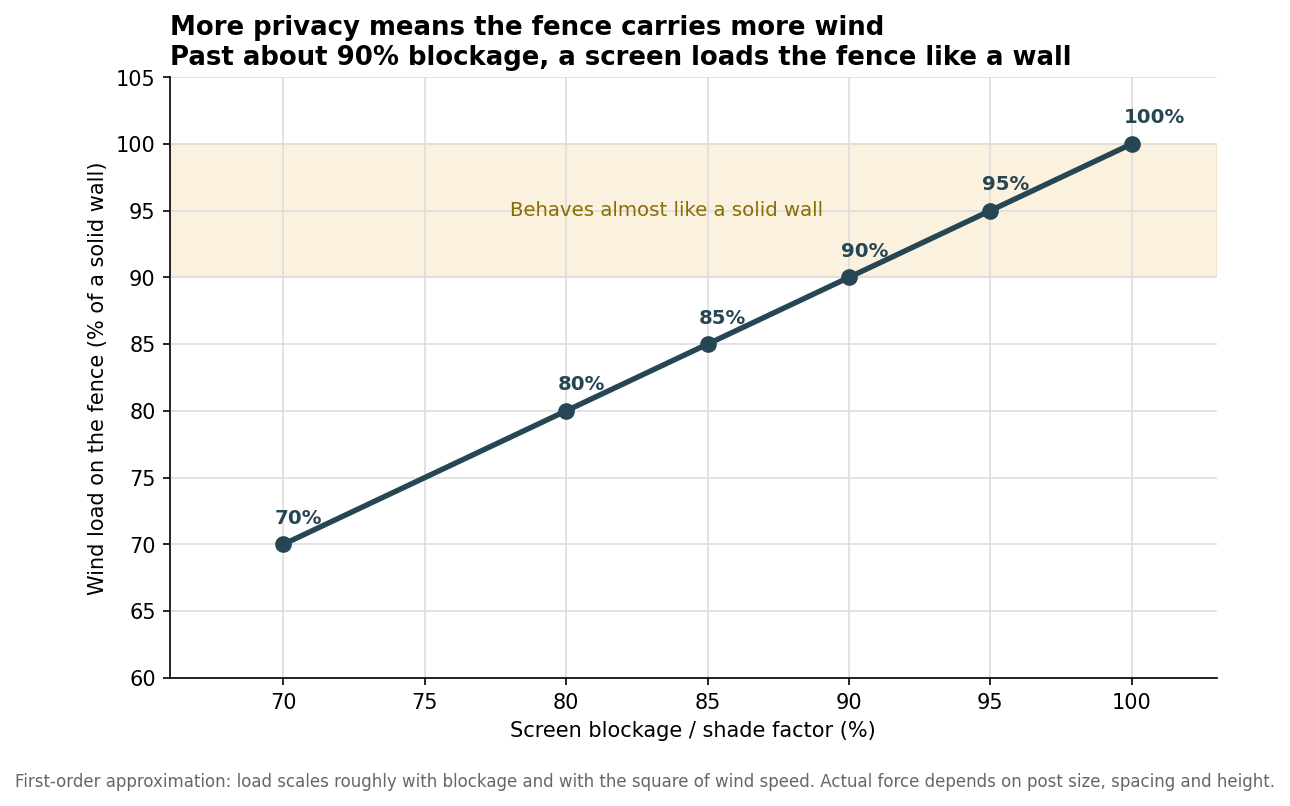
    The reason blockage is not a simple more-is-better dial is that the wind the screen stops does not disappear; it becomes force on the fence. Wind pressure scales with the square of wind speed, so doubling the wind roughly quadruples the load, and a denser screen hands more of that load to your posts and fabric. Under standard wind-engineering assumptions, a solid ten-foot fence section of about 60 square feet can see on the order of 1,500 pounds of force in a 100-mph event. A breathable mesh relieves some of that by letting air pass; a 95-to-98 percent screen behaves much more like that solid wall.

    Line chart showing wind load on a fence rising with screen blockage percentage, approaching a solid wall past 90 percent
    Wind load rises with blockage; past about 90 percent a screen loads the fence much like a solid wall.

    The practical consequence is counterintuitive: the windier the site, the lower the blockage you often want. On an exposed field or a coastal fence line, dropping from 95 percent to 80 or 85 percent can be the difference between a fence that rides out a gale and one that leans or tears. Where maximum privacy is non-negotiable and the wind risk is real, the answer is not a denser screen but a stronger fence: heavier posts, closer post spacing, and proper tensioning, or a vented screen with wind slits that let gusts through. Vents help, but they are a partial measure, not a substitute for the right posts.

    Match the blockage to the site

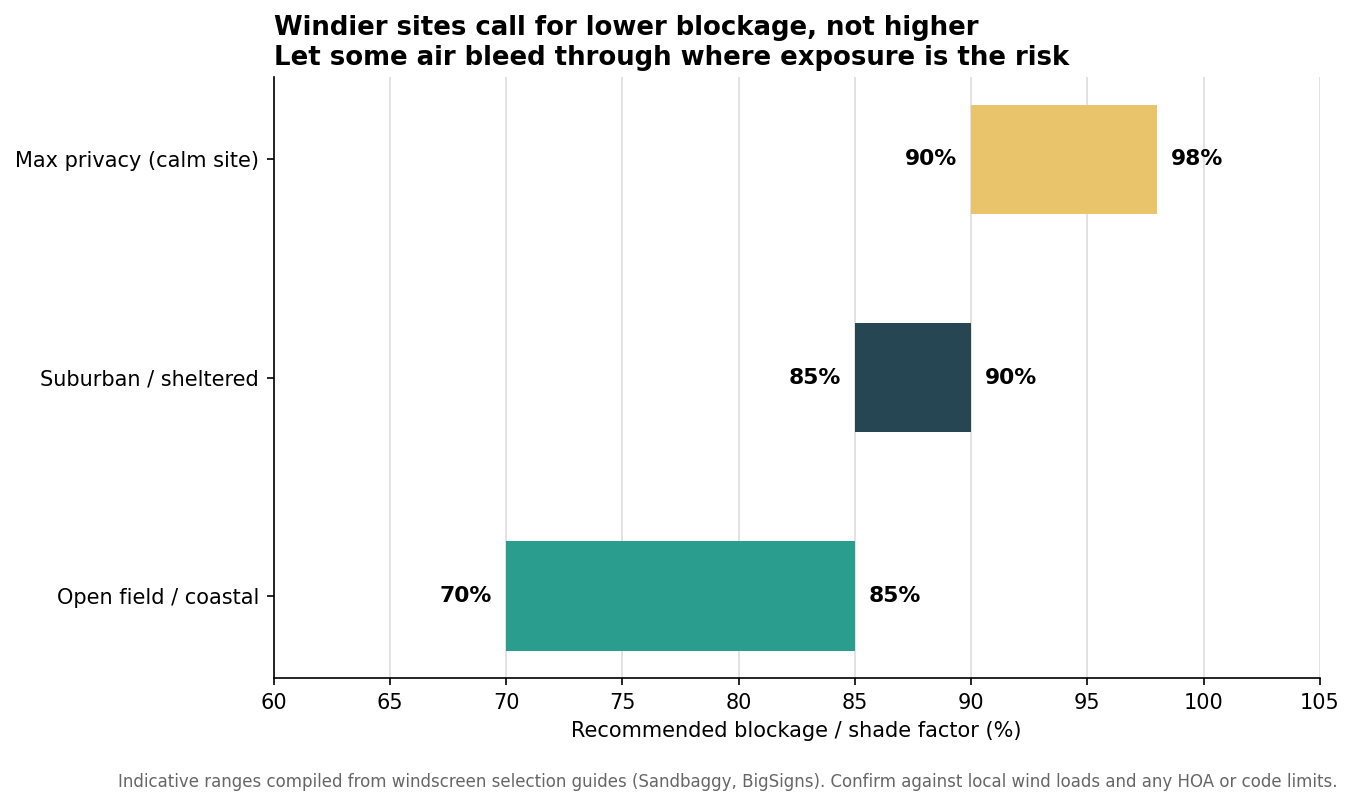
    Turning that trade-off into a spec means reading the site before the catalog. An open, wind-exposed location wants breathability; a sheltered urban courtyard can carry more opacity safely; a low-wind spot where privacy is everything can push toward the top of the range.

    Range bars of recommended blockage by site: open/coastal 70 to 85, suburban 85 to 90, max privacy calm site 90 to 98
    Recommended blockage falls, not rises, as a site gets windier and more exposed.

    These are starting points, not guarantees. A local building department or an HOA may cap fence opacity or height, and a serious installation in a high-wind region should be checked against the actual design wind speed for the area rather than a rule of thumb. But for most projects, choosing blockage by exposure first, and privacy second, avoids the most expensive mistake, which is speccing a beautiful dense screen onto a fence that was never built to hold it.

    Fabric weight and material

    Blockage tells you how the screen performs; fabric weight tells you how long it lasts. Weight is quoted in ounces per square yard or in grams per square meter, and the two convert directly, with one ounce per square yard equal to about 34 grams per square meter. Common windscreen fabrics run from roughly 5 ounces per square yard at the economy end to around 9 ounces for heavy-duty grades; a premium 95 percent screen at about 260 grams per square meter, near 7.7 ounces per square yard, is a representative middle-heavy point. Heavier fabric generally means a tighter knit, higher blockage, and more resistance to stretching and UV breakdown, at the cost of more weight and wind load, so it tracks with the blockage decision rather than being a separate lever.

    The material to ask for is UV-stabilized HDPE, high-density polyethylene, knitted rather than woven so it resists fraying and unraveling if it is nicked. The UV stabilization is what determines whether a screen holds its color and strength through years of sun or goes brittle in a couple of summers, and it is worth confirming rather than assuming. For a branded, full-color printed screen, also ask how the print is applied and whether it is rated for the same outdoor life as the base fabric, since a screen that survives while its graphics fade is only half a success.

    Hardware: grommets, hems, and tie-off

    Most fence screens do not fail in the field of the fabric; they fail at the edge, where the load concentrates. That makes the hem and grommets as important as the mesh. A reinforced hem, typically a folded and stitched border sometimes with a webbing or rope reinforcement, spreads the pulling force so grommets do not tear out. Grommets should sit about every 12 inches around the perimeter, and the installation rule that goes with that spacing is to tie off at every single grommet, not every second or third one. Skipping ties is the most common reason a screen billows, works loose, and elongates the grommet holes until they fail.

    Specify rustproof grommets, brass or a coated metal, so the hardware does not stain the fabric or corrode in weather, and match the tie material to the life of the screen, since cheap zip ties sun-rot and let a panel go long before the fabric is spent. On temporary construction fencing, plan for the screen to be re-tensioned as it settles, and on permanent installs, walk the line after the first big wind and re-snug any ties that have loosened.

    Put those four numbers together and the screen almost specifies itself: pick blockage by how exposed the site is, let that set the fabric weight, insist on UV-stabilized knitted HDPE, and reinforce the edges with 12-inch grommets tied at every point. Do that, and the custom graphics you are really buying the screen for stay up, taut, and legible through the seasons instead of becoming a maintenance problem on a fence that was asked to hold more wind than it could.

  • Custom Fence Screens for HOAs, Pools, and Backyard Privacy — Custom Fence Screens

    Call or Text us: (929) 605-4397

    HomeBlog › Custom Fence Screens for HOAs, Pools, and Backyard Privacy

    HOAs

    Custom Fence Screens for HOAs, Pools, and Backyard Privacy

    07/01/2026

    Homeowners, HOAs, and pool facility operators share a common problem: an existing chain-link fence that’s structurally fine but offers zero privacy and lets wind whip straight through a yard or pool area. A fence screen solves this without replacing the fence itself.

    Here’s how to approach the decision for a residential or community project.

    Why mesh instead of a new fence

    Replacing a chain-link fence with a solid privacy fence usually means a permit, a material and labor cost many times higher, and — in an HOA — a covenant review. A privacy mesh screen attaches to the existing approved fence, so it typically sidesteps all three.

    Choosing a color

    Black and Green are the most common choices because they read as neutral against most landscaping; Beige/Tan and White fit lighter exterior palettes. HOAs standardizing across a community typically pick one color for every homeowner to keep the shared fence line visually consistent.

    Pools: privacy and wind together

    Around a pool, the same mesh reduces both sightlines and evaporative wind loss, without fully sealing the enclosure the way a solid barrier would — which matters for facilities that need to maintain code-required airflow around pool fencing.

    Ordering as an HOA or community

    Community-wide orders are usually easiest handled as one combined quote covering every participating homeowner’s footage, even if delivery and install happen house by house — this locks in one matching color and material for the whole community and better per-foot pricing than individual orders.

    Key takeawayA privacy mesh screen adds privacy and wind-block to an existing fence without the cost or covenant review of a full fence replacement — HOAs get the best pricing and consistency by ordering community-wide as one combined quote.

    See full specs on our Solid Privacy Mesh Screen and Pool & Tennis Court Enclosure Screen product pages, or get a custom quote for your home or community.

    More posts

  • A Property Manager’s Guide to Fence Screen Durability & Wind Load — Custom Fence Screens

    Call or Text us: (929) 605-4397

    HomeBlog › A Property Manager’s Guide to Fence Screen Durability & Wind Load

    Property Managers

    A Property Manager’s Guide to Fence Screen Durability & Wind Load

    06/17/2026

    For a property manager overseeing multiple sites — HOAs, commercial parcels, or multi-family communities — a fence screen isn’t a one-time purchase, it’s a recurring line item. Getting the material and install spec right the first time changes the replacement cycle math for years.

    Here’s how to think about durability and wind load when budgeting across a portfolio.

    Wind load: why partial blockage matters

    A fully solid barrier catches significantly more wind load than a mesh screen at 85–90% blockage. On a long fence run, that difference is the gap between a screen that survives storm season and one that pulls posts out of the ground. For most outdoor applications, knitted mesh is the lower-risk, lower-maintenance choice over solid vinyl.

    Material lifespan and replacement cycles

    UV-stabilized knitted HDPE mesh typically holds color and structural integrity for several years of continuous outdoor exposure before a full-portfolio replacement makes sense. Budgeting a replacement cycle rather than reacting to failures site-by-site keeps costs predictable and lets you buy at better per-unit pricing across a larger combined order.

    Standardizing color and spec across a portfolio

    Ordering the same material, color, and grommet spacing across every site in a portfolio — even if installed in phases — means partial replacements later match exactly, and bulk ordering unlocks better per-linear-foot pricing than ordering site by site.

    Budgeting the numbers

    Bulk pricing for knitted mesh typically runs – per linear foot at minimum order quantity, with per-foot cost improving as combined footage across a portfolio grows. A quote that aggregates multiple sites into one order is usually the most cost-effective way to plan an annual or multi-year fence screen budget.

    Key takeawayStandardize on knitted mesh over solid vinyl for wind-load safety, budget a proactive replacement cycle rather than reacting site-by-site, and combine multi-site orders to unlock better per-foot pricing.

    Managing multiple properties? Get a custom quote for a combined, multi-site order, or read our quantity guide to help plan footage across sites.

    More posts

  • How Many Fence Screen Panels Should You Order? — Custom Fence Screens

    Call or Text us: (929) 605-4397

    HomeBlog › How Many Fence Screen Panels Should You Order?

    Ordering

    How Many Fence Screen Panels Should You Order?

    06/03/2026

    Because we cut fence screens to your exact linear footage rather than selling fixed panel counts, the real question isn’t “how many panels” — it’s “how many linear feet,” plus a small buffer for waste and future repairs.

    Here’s the formula we walk customers through.

    Step 1: Total linear footage

    Measure the full length of every fence section you want covered, in feet. Add each section together for your base total.

    Step 2: Add a buffer

    We recommend adding 3–5% to your measured total to account for corner trims, install adjustments, and a small reserve in case a section ever needs a patch repair down the line.

    Step 3: Factor in future phases

    If you’re screening a property or facility in phases — say, one section of an HOA community now and additional sections next year — ordering your color and material together up front (even if production ships in stages) locks in matching mesh for the whole project.

    Worked example

    ScenarioMeasured footageRecommended order
    Backyard privacy fence120 ft~125 ft
    HOA community phase 1800 ft~830 ft
    Stadium backstop + dugouts340 ft~355 ft
    Key takeawayMeasure total linear footage, add a 3–5% buffer for trims and future repairs, and order matching material up front if your project will be installed in phases.

    Not sure how your measurements translate to a quote? Get a custom quote and we’ll confirm quantity with you, or read our sizes guide for more on height and length planning.

    More posts

  • Custom Fence Screens for Construction Site Safety & Branding — Custom Fence Screens

    Call or Text us: (929) 605-4397

    HomeBlog › Custom Fence Screens for Construction Site Safety & Branding

    Construction

    Custom Fence Screens for Construction Site Safety & Branding

    05/20/2026

    Construction site fencing has to satisfy debris and dust control requirements first — but that same perimeter is also free advertising space for the contractor running the job, if it’s set up right.

    Here’s how contractors typically approach a job-site fence screen order.

    Debris control comes first

    Most municipalities require some form of windscreen around active demolition or construction to control dust and airborne debris. Our 85–90% blockage knitted mesh is the standard density inspectors expect, dense enough to arrest debris while still allowing airflow so the fence structure isn’t overloaded.

    Hi-vis safety color option

    Beyond standard Black, Green, and White, we stock Hi-Vis Safety Orange specifically for job sites that want the screen to double as a visual safety boundary.

    Turning the perimeter into branding

    A required debris screen doesn’t have to be a plain color. Full-color printing lets a contractor put their company name, project rendering, or safety messaging directly on the mesh — so a barrier the site needs anyway also tells the street who’s doing the work.

    Planning around permits and inspections

    Since site fencing often goes up right at permit approval, lead time matters. Standard production ships in 2 weeks after mockup approval; if your permit timeline is tight, ask about rush options when you request your quote.

    Key takeawayJob-site fence screens need to meet debris-control density first — from there, hi-vis color or full-color company branding turns a required barrier into a visible marketing asset.

    See full specs on our Construction Site Windscreen product page, or get a custom quote for your next project.

    More posts

  • Solid Privacy Mesh vs. Full-Color Printed Fence Screens — Custom Fence Screens

    Call or Text us: (929) 605-4397

    HomeBlog › Solid Privacy Mesh vs. Full-Color Printed Fence Screens

    Buyer guides

    Solid Privacy Mesh vs. Full-Color Printed Fence Screens

    05/06/2026

    The two most common fence screen decorations solve different problems, and most buyers end up choosing based on whether the goal is privacy, branding, or a mix of both.

    Here’s a side-by-side comparison to help you decide.

    Comparison

    FactorSolid Privacy MeshFull-Color Printed Mesh
    Best forBackyard/HOA privacy, wind-blockSponsor branding, marketing, mascots
    Color optionsBlack, Green, Beige/Tan, WhiteFull CMYK + Pantone match
    Typical costLower end of rangeHigher end of range
    DurabilityYears outdoors, UV-stabilizedYears outdoors, dye embedded in fiber
    Lead time2–2 weeks2–2 weeks

    When solid mesh wins

    If the goal is purely to block sightlines and cut wind on a backyard or HOA fence, solid mesh is the simpler, more economical choice — there’s no artwork to design or approve, just a color selection.

    When full-color print wins

    If the fence line is doing marketing work — sponsor logos on a stadium fence, branding on a construction site, a business’s storefront perimeter — full-color dye-sublimation printing reproduces detailed artwork and Pantone-matched colors that a solid screen can’t.

    Durability: is print less durable than solid color?

    No. Because we dye-sublimate the print into the mesh fiber rather than printing on the surface, printed mesh holds up outdoors similarly to solid-color mesh — both are UV-stabilized knitted HDPE at the core.

    Key takeawayChoose solid mesh for pure privacy and wind-block at the lowest cost; choose full-color print when the fence line needs to carry a logo, sponsor grid, or brand message.

    Compare both options directly: Solid Privacy Mesh Screen and Full-Color Printed Mesh Banner, or get a custom quote for either.

    More posts

  • Custom Fence Screens for Sports Fields & Stadium Fencing — Custom Fence Screens

    Call or Text us: (929) 605-4397

    HomeBlog › Custom Fence Screens for Sports Fields & Stadium Fencing

    Sports

    Custom Fence Screens for Sports Fields & Stadium Fencing

    04/22/2026

    Sports fields and stadiums are one of the highest-value use cases for custom fence screens, because a fence wrap around a field puts sponsor and program branding in front of every player, parent, and spectator for an entire season — not just during a single game.

    Here’s how athletic departments and league operators typically plan a facility-wide fence screen order.

    Where wraps go

    The most common install locations are dugout fencing, backstop and outfield fencing, bleacher rails, and scoreboard surrounds. Each has different dimensions and viewing angles, so we measure and cut panels specifically for each location rather than one generic size.

    Sponsor logo layout

    Most backstop and outfield wraps carry a grid of sponsor logos — commonly 6 to 12 per wrap depending on panel size. We lay these out in your mockup so every sponsor gets clean, undistorted space, Pantone-matched to their brand colors.

    Material choice for athletic facilities

    Knitted HDPE mesh is the standard here — it holds up to a full season of weather and incidental contact from foul balls and equipment, and it’s reinstallable season after season rather than a single-use product.

    Planning around your season

    Order ahead of a season opener with enough lead time for mockup approval (24–48 hours) plus standard production (2–2 weeks) — most athletic departments start this process 4–6 weeks before opening day to leave room for sponsor sign-off on artwork.

    Key takeawayMeasure each fence location separately, plan for a sponsor logo grid, and start the order at least a month before your season opener to leave time for mockup approval and production.

    See specs for this use case on our Sports Field & Stadium Wrap product page, or get a custom quote for your facility today.

    More posts