Specifying a custom fence screen comes down to a handful of numbers, and getting them right matters more than the artwork printed on top. A screen that is too dense for an exposed site can drag down a fence in a storm; one that is too light gives away the privacy you were paying for; and hardware chosen without thought is where most field failures start. If you can answer four questions with actual figures, you can order a screen that does its job for years instead of one you are re-tensioning every season.
Those four questions are how much you need to block, how that blockage loads the fence, how heavy the fabric should be, and how it attaches. Here is how to put a number to each.
Start with the blockage percentage
The headline spec on any fence screen is its blockage, also called opacity or shade factor, and it does double duty. A screen rated at 85 percent blocks roughly 85 percent of the view and, usefully, stops roughly the same share of the wind that hits it while letting about 15 percent bleed through. Commercial screens generally run between 70 and 95 percent, and that range is not a quality ladder where higher is always better; it is a set of trade-offs you pick from. Seventy to eighty percent gives strong privacy while staying noticeably breathable. Eighty-five to ninety percent is the common middle for sites that want privacy without behaving like a wall. Ninety-five percent and up approaches a solid barrier, which looks great and hides everything, but changes how the fence has to be built.
Blockage versus wind load
The reason blockage is not a simple more-is-better dial is that the wind the screen stops does not disappear; it becomes force on the fence. Wind pressure scales with the square of wind speed, so doubling the wind roughly quadruples the load, and a denser screen hands more of that load to your posts and fabric. Under standard wind-engineering assumptions, a solid ten-foot fence section of about 60 square feet can see on the order of 1,500 pounds of force in a 100-mph event. A breathable mesh relieves some of that by letting air pass; a 95-to-98 percent screen behaves much more like that solid wall.
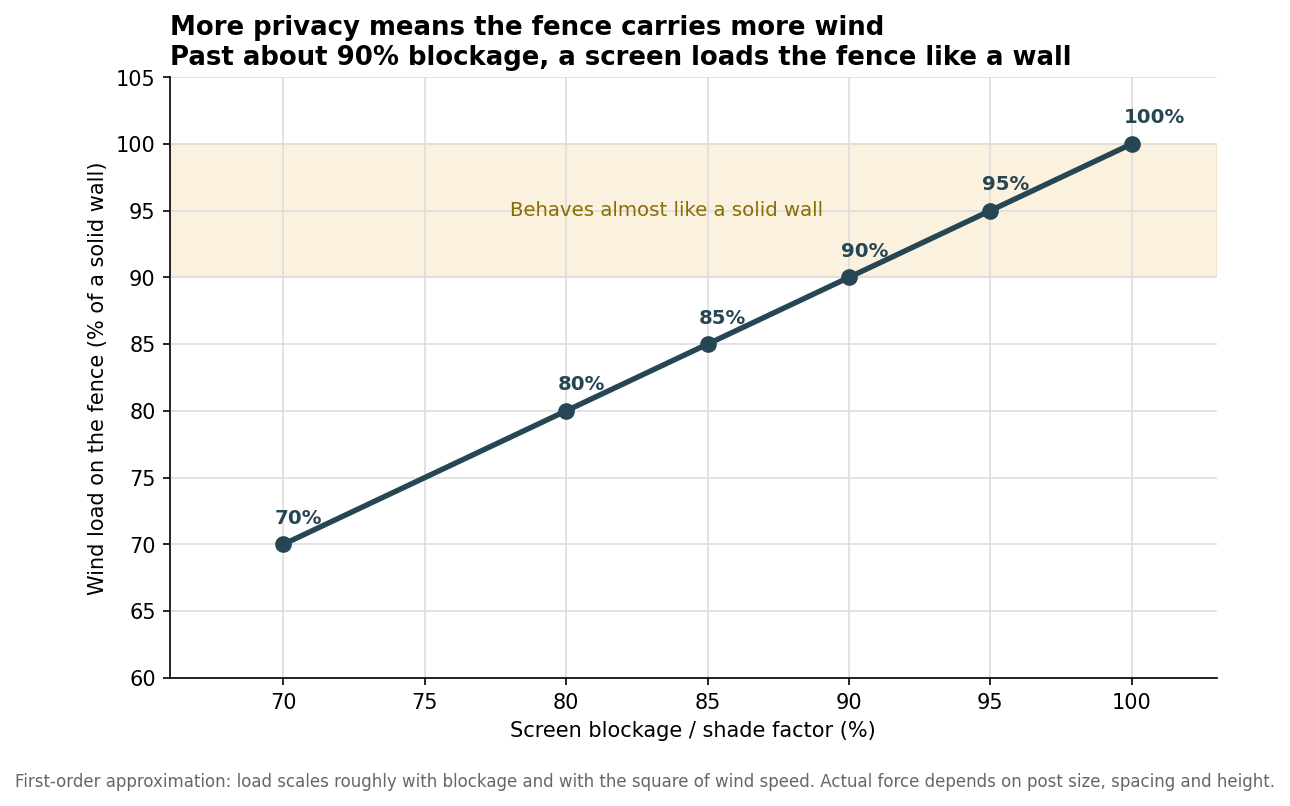
The practical consequence is counterintuitive: the windier the site, the lower the blockage you often want. On an exposed field or a coastal fence line, dropping from 95 percent to 80 or 85 percent can be the difference between a fence that rides out a gale and one that leans or tears. Where maximum privacy is non-negotiable and the wind risk is real, the answer is not a denser screen but a stronger fence: heavier posts, closer post spacing, and proper tensioning, or a vented screen with wind slits that let gusts through. Vents help, but they are a partial measure, not a substitute for the right posts.
Match the blockage to the site
Turning that trade-off into a spec means reading the site before the catalog. An open, wind-exposed location wants breathability; a sheltered urban courtyard can carry more opacity safely; a low-wind spot where privacy is everything can push toward the top of the range.
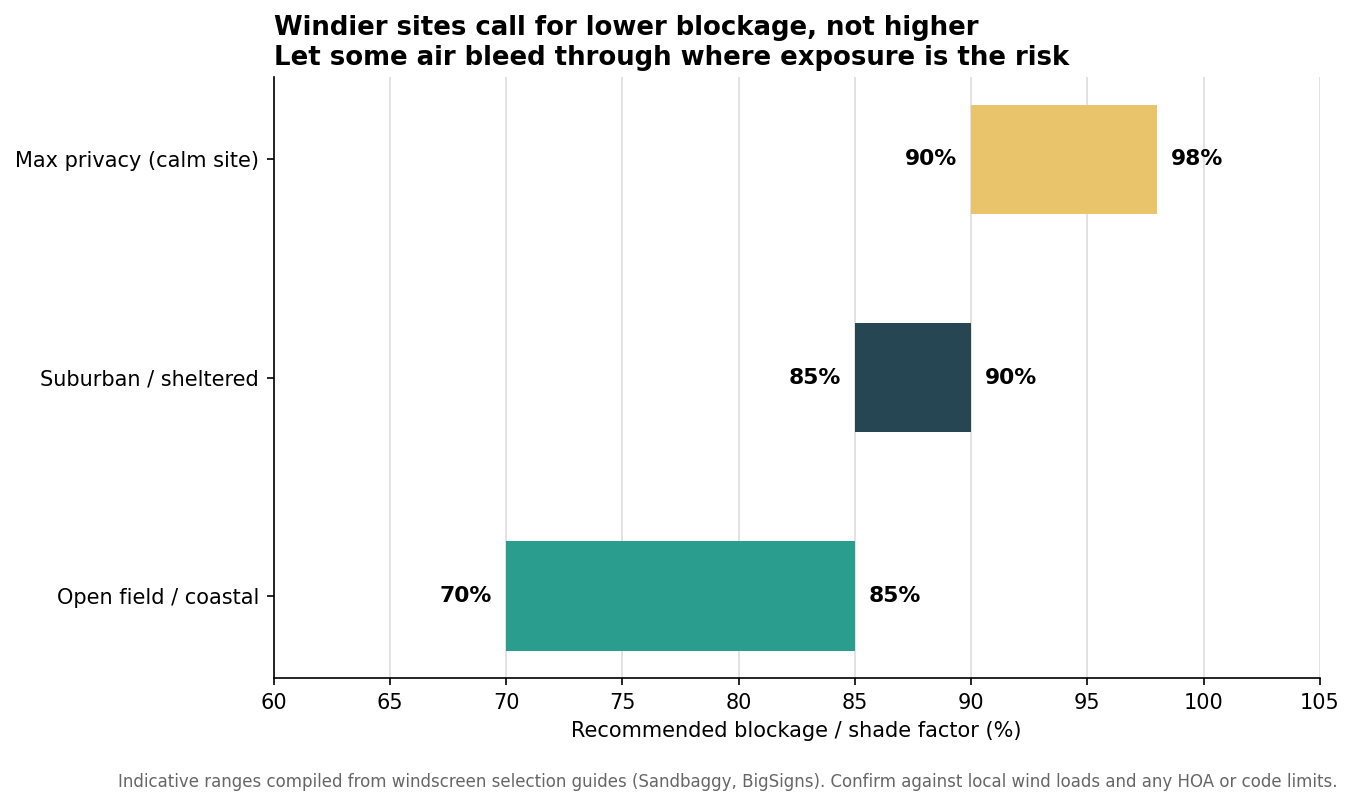
These are starting points, not guarantees. A local building department or an HOA may cap fence opacity or height, and a serious installation in a high-wind region should be checked against the actual design wind speed for the area rather than a rule of thumb. But for most projects, choosing blockage by exposure first, and privacy second, avoids the most expensive mistake, which is speccing a beautiful dense screen onto a fence that was never built to hold it.
Fabric weight and material
Blockage tells you how the screen performs; fabric weight tells you how long it lasts. Weight is quoted in ounces per square yard or in grams per square meter, and the two convert directly, with one ounce per square yard equal to about 34 grams per square meter. Common windscreen fabrics run from roughly 5 ounces per square yard at the economy end to around 9 ounces for heavy-duty grades; a premium 95 percent screen at about 260 grams per square meter, near 7.7 ounces per square yard, is a representative middle-heavy point. Heavier fabric generally means a tighter knit, higher blockage, and more resistance to stretching and UV breakdown, at the cost of more weight and wind load, so it tracks with the blockage decision rather than being a separate lever.
The material to ask for is UV-stabilized HDPE, high-density polyethylene, knitted rather than woven so it resists fraying and unraveling if it is nicked. The UV stabilization is what determines whether a screen holds its color and strength through years of sun or goes brittle in a couple of summers, and it is worth confirming rather than assuming. For a branded, full-color printed screen, also ask how the print is applied and whether it is rated for the same outdoor life as the base fabric, since a screen that survives while its graphics fade is only half a success.
Hardware: grommets, hems, and tie-off
Most fence screens do not fail in the field of the fabric; they fail at the edge, where the load concentrates. That makes the hem and grommets as important as the mesh. A reinforced hem, typically a folded and stitched border sometimes with a webbing or rope reinforcement, spreads the pulling force so grommets do not tear out. Grommets should sit about every 12 inches around the perimeter, and the installation rule that goes with that spacing is to tie off at every single grommet, not every second or third one. Skipping ties is the most common reason a screen billows, works loose, and elongates the grommet holes until they fail.
Specify rustproof grommets, brass or a coated metal, so the hardware does not stain the fabric or corrode in weather, and match the tie material to the life of the screen, since cheap zip ties sun-rot and let a panel go long before the fabric is spent. On temporary construction fencing, plan for the screen to be re-tensioned as it settles, and on permanent installs, walk the line after the first big wind and re-snug any ties that have loosened.
Put those four numbers together and the screen almost specifies itself: pick blockage by how exposed the site is, let that set the fabric weight, insist on UV-stabilized knitted HDPE, and reinforce the edges with 12-inch grommets tied at every point. Do that, and the custom graphics you are really buying the screen for stay up, taut, and legible through the seasons instead of becoming a maintenance problem on a fence that was asked to hold more wind than it could.
Leave a Reply