A custom fence screen is an outdoor textile that fights sun, wind, and grit every single day it hangs. That is why the honest answer to “how long will it last” is a wide one: depending on the material and how it is hung and maintained, a fence screen lasts roughly 1 to 10 years. The spread is not random. It comes down to the polymer you start with, the opacity you choose, and how well the screen and the fence share the wind between them.
What actually wears a fence screen out
Sunlight is the main clock. Ultraviolet light slowly breaks down the plastic in the fabric, first fading the color and then making the fibers brittle until they split at the points that carry the most stress. Wind is the second force: constant flexing fatigues the material and tugs at the grommets and hems that hold it to the fence. Add abrasion where the screen rubs against chain-link, plus trapped dirt and mildew that hold moisture against the fibers, and you have the full picture of what ages a screen. Because UV and wind do most of the damage, the two things worth paying for are a fabric that resists sunlight and a hanging method that keeps wind load under control. Climate tips the scale as well: intense year-round sun in the South and Southwest ages a screen faster than the same fabric in a cloudier, milder region, so a lifespan that reads as generous in one market can run short in another.
Material sets the baseline
The cheapest screens use lightweight polyethylene and last about 1 to 3 years outdoors before they fade and go brittle. High-density polyethylene, or HDPE, knitted mesh is the standard for durability, and entry-level HDPE often carries a 2 to 3 year warranty even though real service life with reasonable care usually runs longer. Heavy-duty HDPE, made with thicker yarns, a denser knit, and ultraviolet inhibitors built into the resin, is what reaches the top of that 1 to 10 year band. Printed screens add one more variable, because the lifespan depends on the ultraviolet package in the ink and coating as much as on the base fabric.
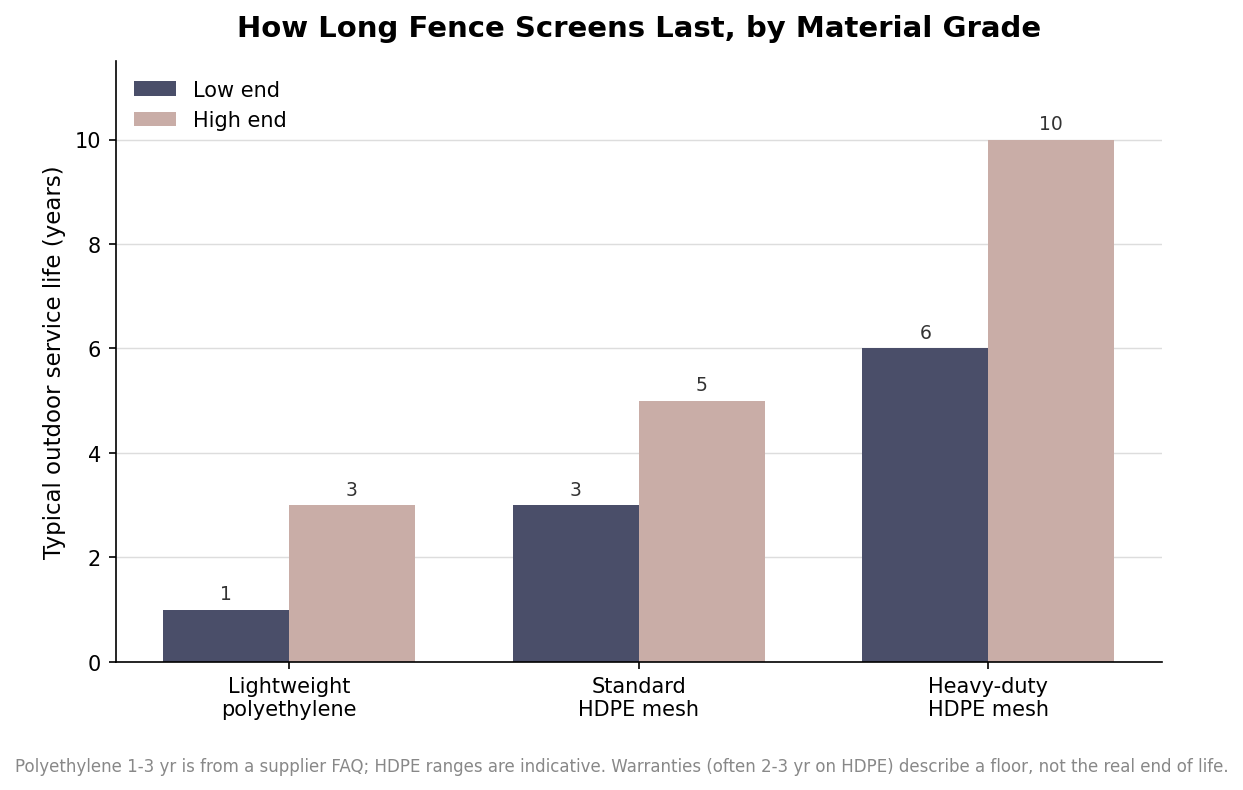
Within HDPE, three specifications separate a two-season screen from a ten-season one. Fabric weight matters because a heavier knit puts more polymer between the sun and the yarn cores. Denier, the thickness of the individual yarns, decides how much abrasion and flexing the fabric shrugs off. And whether ultraviolet inhibitors are compounded into the resin, rather than sprayed on, determines how fast the sun does its work. Treat the warranty as a useful proxy for a manufacturer’s confidence, not as the moment the screen dies. As a rough rule, each step up in weight and denier buys both a few more seasons of life and a screen that holds its printed color longer before it chalks and fades.
Opacity is a durability decision, not just a privacy one
The block percentage you choose is also a wind decision. A screen rated at 85 percent stops roughly 85 percent of the wind and lets the remaining 15 percent bleed through. Higher opacity blocks more wind, but it also transfers more load to your fence, because a near-solid 95 to 98 percent screen behaves like a sail. Lower-opacity mesh in the 70 to 85 percent range actually survives storms better, since the air passing through fills the low-pressure pocket behind the screen and relieves the stress that would otherwise tear it or flatten the fence. The denser the screen, the more force both it and your posts have to survive.
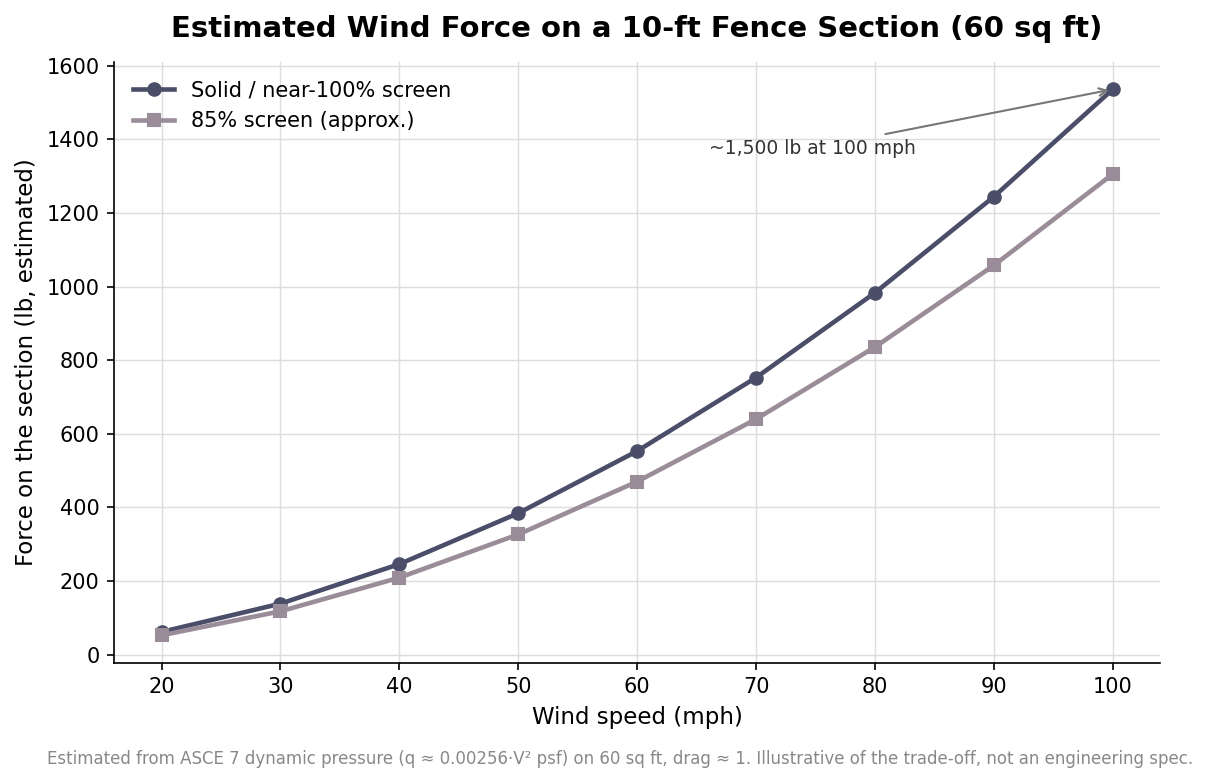
The reason this matters so much is that wind force grows with the square of wind speed: doubling from 30 to 60 miles per hour roughly quadruples the load. Under standard ASCE 7 assumptions at 100 miles per hour, a single 10-foot section presenting about 60 square feet of solid surface can see on the order of 1,500 pounds of force. That is why high-opacity screens on exposed sites need stronger posts, tighter post spacing, and often wind vents. Vents help relieve gusts, but they are a partial measure rather than a replacement for proper structure.
Getting more seasons out of a screen
Installation and care decide where in the range you land. Hang the screen taut but not drum-tight, and fasten it often enough, commonly every 6 to 12 inches, that no section is left to flap in the wind, since flapping is what fatigues fabric and rips out grommets. On exposed runs, leave wind gaps or choose vented panels rather than fighting the load with fabric alone. Keep the screen clean by rinsing off dirt and treating mildew, because grime and abrasion speed up ultraviolet wear. Where it is practical, take screens down ahead of extreme storms or over an off-season. And buy for the actual environment: a full-sun, high-wind, or coastal site justifies heavy-duty UV-stabilized HDPE, because replacing a cheap screen every other year quietly costs more than installing one good one.
Match the material to the exposure
A shaded, low-wind residential run can get away with lighter mesh and still look good for years. An exposed commercial yard, a sports field, or a coastal property should start from heavy-duty, UV-stabilized HDPE and then size the structure for the opacity chosen, not the other way around. The screen and the fence age together as a system, and the fabric you pick along with the way you hang it is what decides whether that system gives you three seasons or ten.
Leave a Reply